

Permanent Full-Arch Teeth with All-on-4 Dental Implants
Restore your smile with All-on-4 Dental Implants at Beautica Clinic. This advanced treatment replaces a full arch of missing teeth using just four strategically placed dental implants, giving you a secure, natural-looking smile with improved comfort, function, and confidence.
What All-on-4 actually means
All-on-4 replaces a whole arch of teeth — the upper or the lower — with a fixed bridge carried by four implants. Two are placed upright at the front of the jaw, where bone is usually densest. The other two are tilted backwards at an angle, so they reach available bone instead of needing a graft first. That tilt is the whole idea: it is what makes the technique possible in jaws that would otherwise be told to graft and wait.
The result is fixed. It is screwed or cemented in place and you do not take it out at night, which is the practical difference between this and a denture.
Who All-on-4 suits — and who it does not
It suits adults who have lost most or all of the teeth in one arch, and adults whose remaining teeth are failing badly enough that saving them would mean extractions, root canal treatment and crowns on almost every tooth. It also suits people who have worn a denture and cannot tolerate the movement, the bulk or the palate coverage.
It is not automatic, and it is not the right answer for everyone:
- If bone volume is very low, a graft or a different technique may be needed first — the CBCT scan tells us which.
- Heavy smoking, uncontrolled diabetes and untreated gum disease all lower the success rate. They are addressed before surgery, not after.
- If you are missing one or two teeth, single implants are simpler, cheaper and better.
- If you grind your teeth heavily, the final bridge needs a night guard, or it will chip.
All-on-4 or All-on-6?
Six implants spread the load over more bone and shorten the unsupported span at the back of the bridge; four implants mean less surgery and are enough in most jaws. The decision is made on the scan, not on preference: we measure bone height, width and density in the exact positions that matter, then tell you which version your anatomy supports. If both are possible, we say so, and explain what the extra implants buy you. Read the All-on-6 comparison for the other side of that decision.
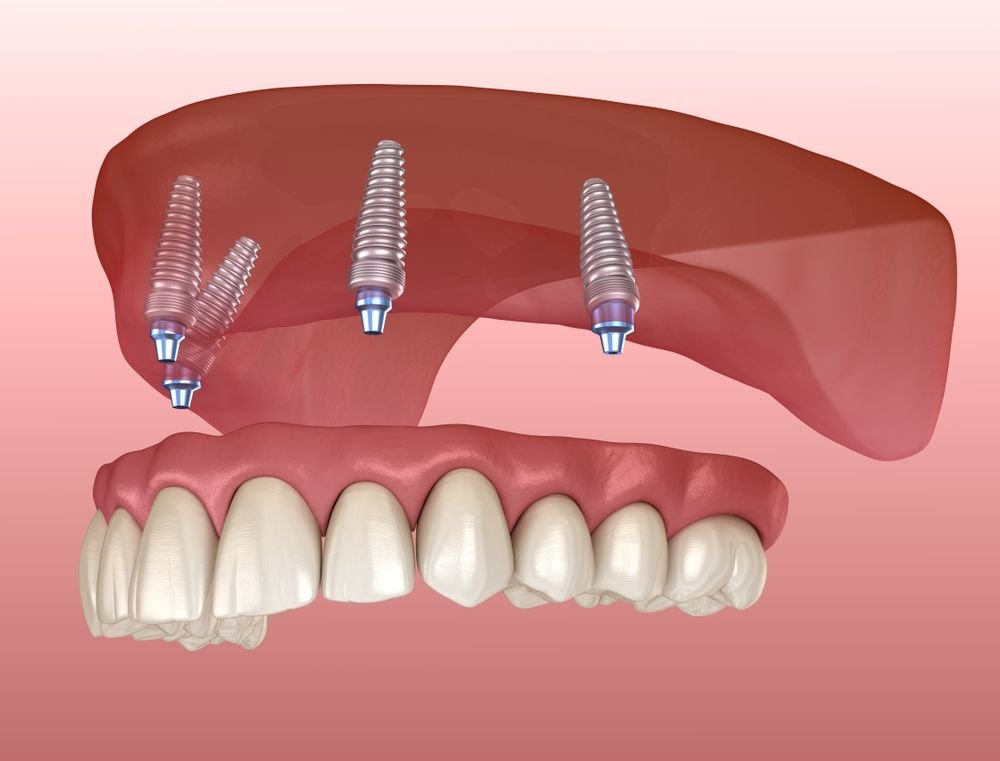
Why Choose All-on-4 Dental Implants in Istanbul?
- Replace a full arch of missing teeth with just four implants
- Fixed, secure alternative to removable dentures
- Natural appearance and comfortable fit
- Improved chewing and speaking ability
- Helps preserve jawbone health
- Long-lasting solution with proper care
Our experienced implant dentists create a personalized treatment plan to restore your smile using the latest digital technology.
Planned on a scan, not on a guess
Every All-on-4 case starts with a 3D CBCT scan and an intraoral scan. Together they show bone height, bone width, the position of the nerves in the lower jaw and the sinus floor in the upper, so implant length and angle are chosen before the day of surgery rather than improvised during it. The surgical guide is made from that plan.
What “same-day teeth” really means
In most cases a temporary bridge is fitted on the day of surgery, so you leave with teeth rather than with nothing. It is deliberately lighter and softer than the final bridge: it is there to look right, protect the gums and let you eat soft food while the implants fuse to bone. The permanent bridge is made later, once healing is complete and the gums have settled into their final shape — fitting it earlier is how full-arch work ends up with gaps and fractures.
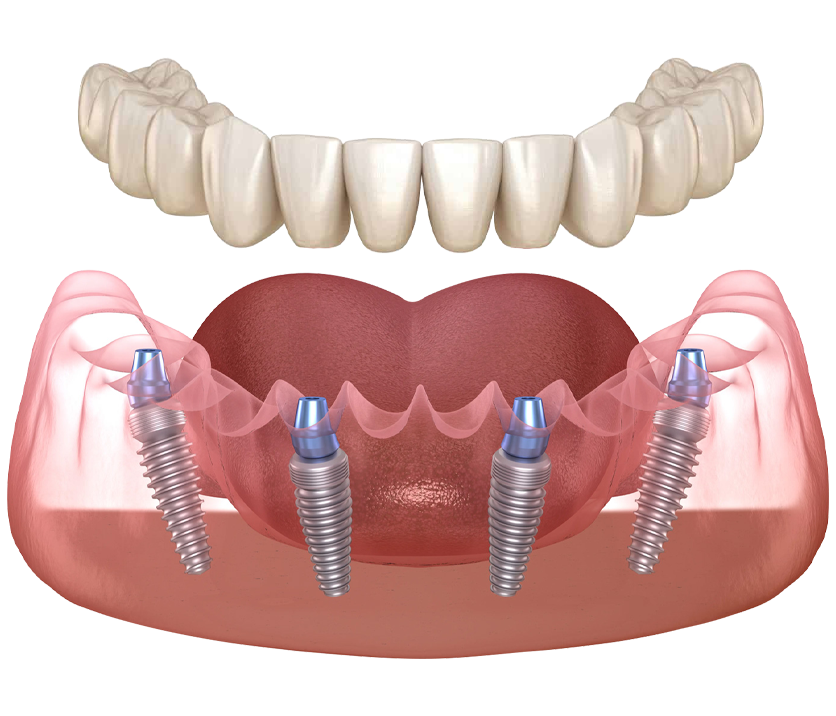
Our All-on-4 Treatment Process in Istanbul
Your journey begins with a comprehensive consultation, including digital scans and a detailed assessment. Four dental implants are precisely placed to support a full arch of replacement teeth. In many cases, patients can receive temporary teeth on the same day, followed by a custom permanent restoration after healing.
What happens on each visit
Consultation and planning. Examination, CBCT scan, photographs and a written plan: how many implants, where, which prosthesis, and what has to be treated first. If you are travelling, this can be done remotely from your own dentist’s scans and photographs before you book a flight.
Surgery. The implants are placed under local anaesthetic, with sedation available if you want it. Most patients describe the day itself as easier than expected; the discomfort usually arrives on days two and three and is managed with ordinary painkillers.
Temporary bridge. Fitted the same day or within a few days, depending on swelling and on how the implants behaved during surgery.
Final bridge. After three to six months of healing, once the implants are stable and the gums have matured. This is the appointment where bite, speech and appearance are refined.
The healing months
During healing you eat soft food, clean around the temporary bridge carefully, and avoid putting load on the front of the arch. Smoking in this window is the single most reliable way to make an implant fail. We check healing with a short review, in person or with your local dentist sending us photographs.
After the final bridge is fitted
A fixed full-arch bridge is cleaned daily — brushing, plus cleaning underneath it with interdental brushes or a water flosser — and reviewed every six months. The implants themselves do not decay, but the gums and bone around them can inflame, and the acrylic or ceramic teeth in the bridge can chip. Both are manageable when they are caught early.
How this compares with dentures
A denture rests on the gums, moves when you chew, and covers the palate in the upper jaw, which changes how food tastes. An implant bridge is fixed to the bone, so chewing force goes into the jaw rather than into the gum, and nothing is removed at night. That difference is why most patients who move from a denture to All-on-4 describe it as a change in eating rather than a change in appearance.
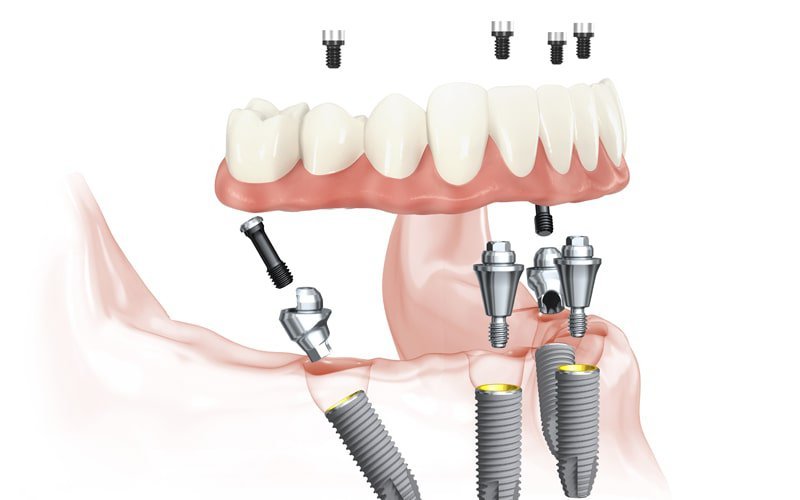
All-on-4 Dental Implants: FAQ
What are All-on-4 dental implants?
All-on-4 is a full-mouth restoration that uses four dental implants to support a complete arch of fixed replacement teeth.
Who is a good candidate for All-on-4?
Most adults with multiple missing or failing teeth may be suitable candidates. A consultation will determine if the treatment is right for you.
How long does the procedure take?
Implant placement is typically completed in one appointment, and many patients leave with temporary teeth the same day.
Can All-on-4 be done if I have been told I need a bone graft?
Often, yes — the tilted implants exist precisely to use the bone that is left in the front of the jaw. But not always: if the remaining bone is too thin or too soft, a graft or a different technique is the safer answer, and a CBCT scan is the only way to know which situation you are in.
Do I get permanent teeth on the day of surgery?
You get a fixed temporary bridge in most cases. The permanent bridge is made after the implants have healed, usually three to six months later, because the gums change shape during healing and a final bridge fitted too early leaves gaps underneath.
How much bone do I need for All-on-4?
Enough for four implants in the positions the plan requires — usually the front of the jaw, where bone is densest. There is no single number in millimetres that applies to everyone; the answer comes from measuring height, width and density on a scan.
What can go wrong?
The main risks are infection, an implant that fails to fuse, chipping of the temporary bridge, and speech or bite changes while you adapt. Serious complications are uncommon, and most of them are cheaper to prevent than to repair — which is why smoking, uncontrolled diabetes and gum disease are dealt with first.
Is the treatment painful?
The procedure is performed under local anesthesia or sedation for your comfort. Mild discomfort during recovery is normal and usually manageable.
Are All-on-4 implants permanent?
The implants are designed to be a long-term solution. With good oral hygiene and regular dental check-ups, they can last for many years.
How do I care for All-on-4 implants?
Daily brushing, flossing, and routine dental visits help keep your implants and replacement teeth in excellent condition.
Will I be able to eat normally?
Yes, once the final bridge is in place. During the healing months you stay on soft food. Afterwards you eat what you ate with natural teeth, with two exceptions worth keeping: ice and bones are hard enough to chip ceramic, and opening packets with your teeth is how bridges break.
Will it change how I speak?
For the first week or two, yes — especially if you wore a denture, because the palate is no longer covered. Most patients adapt quickly. If a sound stays difficult after the temporary phase, tell us: it is usually a thickness or position detail in the bridge, not something you have to live with.
Can I have All-on-4 in one jaw only?
Yes. Plenty of patients have a full arch on one side and natural teeth, a partial denture or single implants on the other. The plan is built per arch, not per mouth.
How long does the whole process take, start to finish?
Surgery and the temporary bridge happen in one trip, usually five to seven days in Istanbul. The final bridge is fitted after three to six months of healing, on a second shorter visit. Some patients complete the final stage with a dentist at home using our records.
Book Your All-on-4 Consultation
Ready to restore your smile with All-on-4 Dental Implants?
Contact Beautica Clinic today to schedule your consultation and discover a permanent solution for missing teeth.